Showing posts with label alternative history. Show all posts

Thursday, February 06, 2025

Emily Wilde’s Map of the Otherlands by Heather Fawcett: review

5/5 stars on Goodreads

Emily Wilde's Map of th Otherlands by Heather Fawcett

Emily Wilde’s Map of the Otherlands is the second book in Fawcett’s delightful alt-history series set in 1910s academia. Emily Wilde is a researcher in dryadology that studies fairies and other mythological beings that aren’t mere folktales in this universe. She’s a resourceful, no-nonsense woman in her early thirties, and the books are narrated as her journal entries.

In the first book, she conducted field studies in Norway with her colleague and academic rival Wendell Bambleby, but it turned out he’s not a human but an exiled king of a fairyland. He’s joined academia because he’s searching for the door to his dominion. The two became romantically involved and he even asked for her to marry him. She didn’t give him an answer.

In this second book, the pair sets out to search for the door. Emily has become convinced that a researcher who disappeared in the Austrian Alps fifty years earlier had found a nexus that is a door to several places simultaneously, Wendell’s kingdom included. All they have to do is trace her footsteps.

Joining them is their head of department, Professor Rose, who doesn’t trust her research methods, and Emily’s niece and assistant, Ariadne, who is a bit afraid of her and a lot afraid of Wendell, after learning who he truly is.

They find themselves in a tiny village in the middle of nowhere surrounded by borderlands to fairy and with people who are at least partially fay themselves. Finding the door isn’t easy though, even if the villagers can pinpoint the exact place where the researcher disappeared, and have seen her wandering around for decades, lost in the fairylands. Making things even more difficult are the hostile or mischievous fairies attacking or hindering them, and the assassins sent by Wendell’s step-mother who has usurped his throne.

The biggest problem is, however, that Wendell has been poisoned by the assassins. They try everything to cure him, but in the end the only solution is for Emily to travel to his kingdom for a special cure. It’s never wise for a human to go to fairy, and less so when the place is ruled by the person who wants them both dead.

This was another great book. I like Emily’s dry academic tone with which she records everything, with footnotes, and her unwavering belief in herself. Wendell is funny with his fastidious ways, and his devotion to Emily is heartwarming. Professor Rose was a good addition, if annoying at times, and Ariadne was nice, even if she didn’t really rise from the background.

The story flowed smoothly, helped by Emily’s habit of recording only the pertinent. That lowered the tension during the action scenes though, as she left a lot unsaid, but it made the overall feel of the book cozier. And she finally gave her answer to Wendell’s proposal too. Onwards to the next book.

Thursday, October 31, 2024

Hell’s Acre by Lilith Saintcrow: review

3/5 stars on Goodreads

Hell's Acre by Lilith Saintcrow

Hells Acre was a really different book from what I presumed by the description, cover, and previous books by the author I’ve read. I expected a fast-paced alt-world urban fantasy told in first person narrative. But it’s an alt-Victorian gaslamp fantasy told in third person by multiple point of view characters, with an overly florid narrative style that is incredibly slow to read, as every sentence is packed full in a convoluted fashion that forces the reader to go back several times.

The world isn’t what I thought either, based on the description: a country that has refused to accept Christianity and where Rome never fell. I presumed it would be based on Roman gods and traditions, or since this takes place in England, Anglo-Saxon ones, or a combination of both. Mithraism, for example, in the temple of which the book starts, would’ve had rich, distinct rituals and interesting underground architecture that would’ve immediately made this world unique.

What we have is a very traditional Christian setting, like convents structured like Christian ones and organised by gender, and Priories and Abbeys, with a few token words of other religions and cultures in the mix to make it seem something else. Character names are based on Bible. Even the name of the book directs thoughts to Christianity, even if the concept of hell isn’t solely Christian. The world feels half thought out and is a great disappointment.

It took a long time to get a hang of the characters too, as the narrative doesn’t really dwell on their inner thoughts, and reader is more observing them from the outside. Yet, for all the floridity, characters are very sparsely described, and long after the reader has already formed their own image of them.

The story emerges slowly and in a roundabout way, with every character’s POV chapter opening mid-action with little or nothing to orient the reader. Beth, going by Gemma Dove, an orphan, has been living in this world’s version of France to hide her from powers who want her for something that isn’t specified. But her guardian has died and she’s returned to England (Albion) to revenge her parents’ death. She’s well trained in self-defence and believes in her abilities, but it isn’t easy to go after her prey even with powerful backers.

She takes a job as a teacher of boys in an orphanage near the bad part of town, Hell’s Acre, and that fills most of her days, with some adventures in the mix. She catches the attention of Avery Black, who leads a group of vigilantes (or something, I never quite figured out) in Hell’s Acre. Reader doesn’t learn much about him, or Hellions, the organisation he belongs to (but not the vigilantes?), but he’s after the same man as Gemma.

The book description gives to understand that the two team up. However, while their paths cross from time to time, the two don’t realise their mutual goal before the book ends. The ending is a cliffhanger. There’s a hint of interest, but no romance. I’m not sure I need to read more to find out what happens next. The story wasn’t interesting enough, and it was too much work to read, with too little given in return. I’m giving it three stars though, because I did finish it and it doesn’t quite feel like a two-star book despite everything I found lacking.

I received a free copy from NetGalley in exchange for an honest review.

Tuesday, September 05, 2023

All the Dead Shall Weep by Charlaine Harris: review

5/5 stars on Goodreads

All the Dead Shall Weep by Charlaine Harris

All the Dead Shall Weep is the fifth book in Harris’ alt-history western series, Gunnie Rose, set in 1930s America that’s been divided to small, lawless countries. After the events of the previous book in the point of view of Lizbeth’s sister, Felicia, the story returns to Texoma and Lizbeth’s hometown Segundo Mexia, where she has settled with her husband Eli, the grigori prince from the Russian governed San Diego.

But all is not well. Lizbeth has recently suffered a miscarriage and Eli doesn’t seem to care. The arrival of Felicia and Eli’s brother Peter push things to a point, and Eli leaves to his home in San Diego, taking Peter with him. The things he says before he goes indicate that he’s not coming back.

Lizbeth and Felicia are left behind; Felicia mainly because her growing powers as a grigori mean she’s not safe in San Diego. But turns out she’s not safe in Texoma either. Word of her powers have spread and a magic family after another sends their most eligible members to woo her—and not all of them do it nicely. People are targeting Lizbeth too, on top of which a strange militia keeps attacking her hometown.

After several books, the world is familiar and the backstory has grown interesting. Lizbeth is as tough as ever, but with a vulnerable side too. Felicia’s death magic is terrifying, but it’s not a complete cure-all, as the story shows. The narrative alternates between the women, giving the inner thoughts of both of them—and they both have a lot on their plates. Death still comes easily and is easily cast away, but only when it’s about people trying to kill them.

This was a fast-paced, quick read and another excellent book in the series. However, I was a little disappointed with how things were solved between Lizbeth and Eli. It seemed a bit of a copout after everything she went through. The addition of details from Europe, like Agatha Christie’s books and Hitler seemed a bit superfluous, but they help to ground the story in its era and promise interesting things to come. I’m looking forward to reading more.

I received a free copy from NetGalley in exchange for an honest review.

Sunday, February 19, 2023

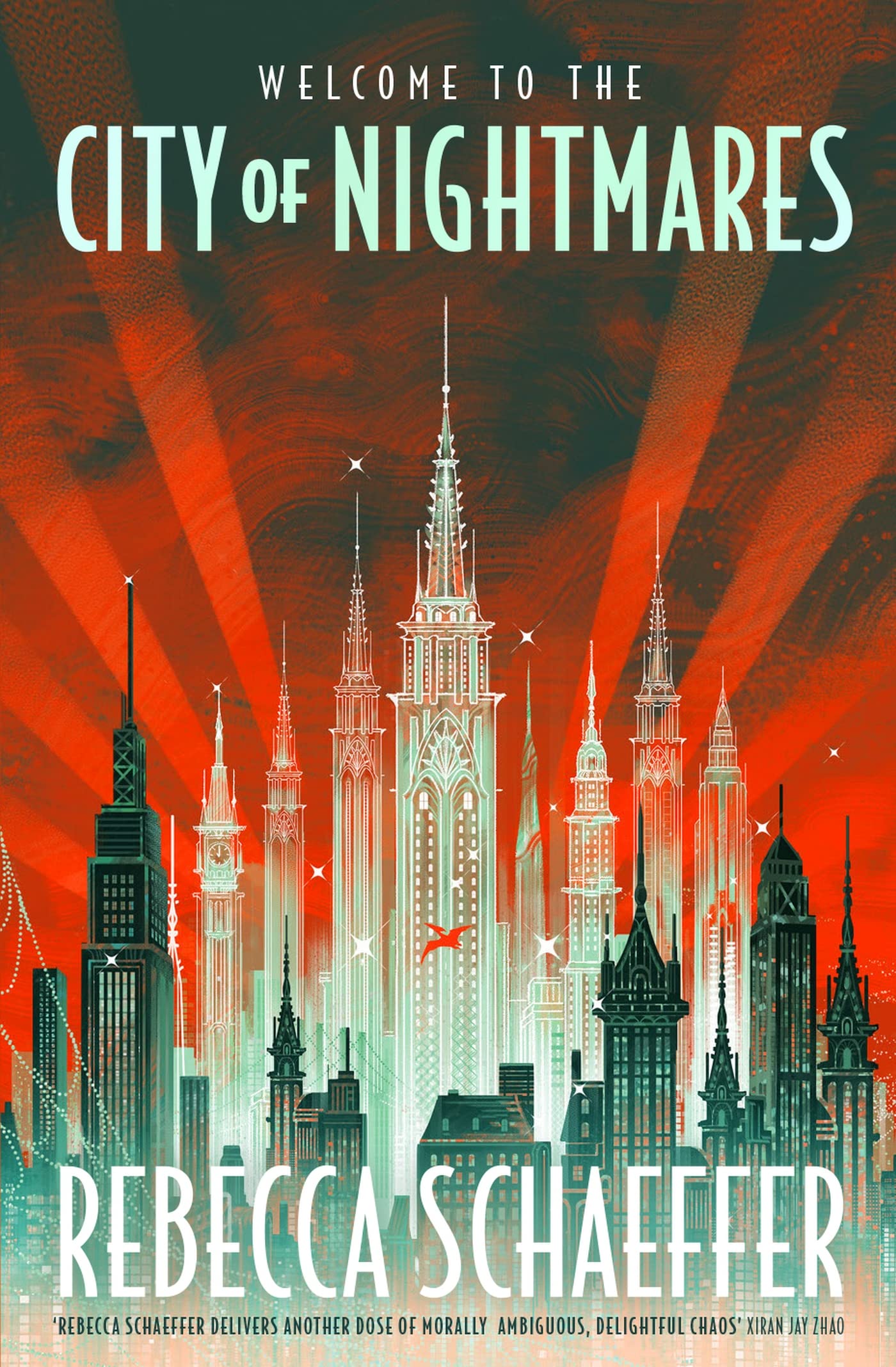
City of Nightmares by Rebecca Schaeffer: review

4/5 stars on Goodreads

City of Nightmares by Rebecca Schaeffer

City of Nightmares is set into an alt-history world of maybe early twentieth century. For a hundred years, peoples’ nightmares have come to life, changing the person to their worst fears. Some become murderous, some live their lives as before, with altered looks.

Nineteen-year-old Ness lives in Newham, hiding among a ‘cult’ that offers therapy for people suffering from the consequences of nightmares. She’s afraid of all of them, to the extent that she becomes completely paralyzed by fear. But nightmares aren’t the only frightening things in Newham, which is run by mobsters and corrupt people who kidnap children to feed them to monsters, among other things.

Her life changes when a boat she’s on explodes and she’s saved by a young vampire man. Not only is she forced to trust him, in the aftermath she starts to question the safe haven she’s been living in. Little by little, she sheds her fears, so much so that when the worst monsters come at her, she’s able to face them with courage.

The book started a bit slowly and it wasn’t very compelling, but it picked up pace towards the end. The assassination plot didn’t make any sense even after it was explained, but luckily it wasn’t the main focus. That was Ness and her fears. Her transformation was believable at first, but then her fears were wiped away with a kind of deus ex machina solution that came out of blue, as her ability to lucid dreaming wasn’t used anywhere else.

Ness was a good character, but at no point did I believe she was an adult, as her inner life and behaviour were more suitable for a fourteen-year-old. Side characters didn’t really come to life, though I liked Cy.

My biggest problem was with the setting, which was a confusing mess. I thought at first that the book took place in 1930s, with Bakelite phones being the height of modernity, but then there were TVs everywhere. I thought Newham was somewhere in the US, but then there was the bit about annexing Sweden, which doesn’t make geographical sense. In the end, I just imagined it was a secondary world and ignored the odd bits.

This was a start of a series, but it has a good conclusion and the book can be read as a standalone. There were enough open questions left, but I’m not curious enough about them to read more.

I received a free copy from NetGalley in exchange of an honest review.

Wednesday, November 23, 2022

The Serpent in Heaven by Charlaine Harris: review

5/5 stars on Goodreads

The Serpent in Heaven by Charlaine Harris

The Serpent in Heaven is the fourth book in Gunnie Rose alt-history fantasy series that takes place in alternative 1930s America that has been divided to several new countries after the Great Depression. Britannia in the east coast is ruled by the British, and former California and Oregon form the Holy Russian Empire ruled by the Tzar Alexei, the haemophilic son of Nikolai II, now an adult. Texas and Oklahoma form Texoma, where the series originally took place, following Lizbeth Rose, a sharpshooter who hires herself as a guard on dangerous missions through the lawless state.

The previous book moved the focus to San Diego, where the Tzar’s court is, and to the machinations of courtiers and grigoris, the powerful magic wielders that are allowed to operate openly in the empire. This book ditched Gunnie completely and focused on her half-sister Felicia, who as a granddaughter of Rasputin is one of the few people whose blood can alleviate the Tzar’s haemophilia.

The change in the point of view was good and put a new gear in the story. In the previous books, Felicia has been the target of people who want to kill all the Tzars blood donors. Now she’s a student in a school for grigoris, trying to lay low, and going through a freakish growth spurt that brings her up to speed with her real age, fifteen, after her father had suppressed her growth with magic for years to keep her safe.

But she isn’t as unnoticeable as she had hoped. While the school empties during an epidemic of Spanish flu, her dead mother’s family comes gunning for her. Their motivation is a bit lame and doesn’t really justify the body-count that ensues. Most of it was caused by Felicia who discovers she is more powerful magic practitioner than she had known.

This was maybe my favourite book in the series so far. The world is more familiar, there was more magic, and the story was fairly straight-forward. Felicia was a very different character from Gunnie, but I liked her voice and character. Having grown up in the slums of Mexico, she was tough and resilient. However, I would’ve liked some reaction from her to all the deaths she caused, but like with Gunnie, they didn’t affect her at all.

The romance was sweet, though maybe unnecessary at this point, especially with all the drama. She’ll end up bossing Peter around if they stay together. Felix was my favourite side character, but others were good too. Gunnie only made a cameo appearance, but she wasn’t needed. All in all, I hope the following books continue with Felicia’s story.

Sunday, October 23, 2022

Babel by R. F. Kuang: review

5/5 stars on Goodreads

Babel by R. F. Kuang

Babel, or The Necessity of Violence: An Arcane History of the Oxford Translators' Revolution was one of my most anticipated books this year, and it lived up the hype. The story is excellent, the style perfect for it, the prose effortless, and execution perfect. It’s not an easy book, but it’s worth the effort.

Set in alternative England of 1830s, it tells the story of Robin Swift who is whisked away from his home in China as a child to live with a demanding scholar in England. His sole purpose is to learn languages well enough to be accepted to Babel, an institution of translation at the heart of Oxford.

Translation is how magic works in that world, the difference between what the words mean powering the spells. For a long time though, magic is in the background of the story, the focus on Robin and his companions. It’s a good narrative choice that allows the story to explore the hostility and racism they face in the academia. At first, academic curiosity and the honour of being in Babel carries them despite the troubles. Little by little, magic rises to the fore and Robin comes to understand that it isn’t for all and moreover, it’s been used for exploiting his people, forcing him to act.

Robin is an excellent character. He’s an observer for most of the time, with events happening to him. And when he does act, the consequences are usually bad for him. His story isn’t easy, and the reader is upset for him for much of the time. His friends are each interesting too, but remain slightly distant.

This was a hefty book, but it didn’t feel long. The narrative flows easily and the story progresses swiftly. The historical world is well researched and believable. The magic system is unique and not without its consequences. The footnotes didn’t work for me as well as I’d hoped though. They don’t form a dialogue with the main narrative like the best do, or add anything useful. Also, in the e-book version, the superscripts were so small that I often didn’t notice them, and then I had to try and search the text for what the footnote referred to.

Babel proves that Miss Kuang can write with brilliance, no matter the genre or topic. I’m definitely looking forward to what ever she chooses to publish next.

I received a free copy from NetGalley in exchange for an honest review.

Tuesday, August 10, 2021

The Bright and Breaking Sea by Chloe Neill: review

4/5 stars on Goodreads

The Bright and Breaking Sea by Chloe Neill

I love alt-history fantasy, with its the manipulations of familiar to create something new. The Bright and Breaking Sea by Chloe Neill is a great example of that.

The book is set in the alternative early 19th century, right after the first Napoleonic wars. Only, Britain is called the Isles, France is Gallia, Queen Charlotte sits on the throne of the Isles in New London and the invading emperor is called Gerard. There’s equality of sorts. Women and people of colour hold important positions in the army and navy, but there are still haves and have-nots, and the white aristocratic male still gets what he wants. There’s no Christianity but two deities who are credited with bringing magic into the world.

Not everyone is able to manipulate magic though. Kit Brightling is a foundling who is Aligned to sea magic. She’s risen to a captain of her own ship despite her young age, and works directly for the Queen, undertaking daring missions for her—not that anyone knows about it. But this time, she’s forced to take an army fellow—and a Viscount to boot—on her ship, which doesn’t sit well with her. Together they handle mission after mission for the Queen and country, unravelling a plot to bring Gerard back to power. Along the way, they become friends, and there’s even love kindling. But sea is a harsh mistress, and Kit has chosen her.

This was a great book with a lot of swashbuckling action, pirates, sea battles, spies, and even romance, though nothing like in Neills urban fantasy books. The alternative details were clever, nautical details rich, the plot was good and well-paced, if slightly simplistic, and there was a lot of action. I liked Kit and how she was allowed to be a formidable captain without constantly reminding the reader that she’s a woman. Grant was a wonderful romantic hero, but he remained sightly distant, as we didn’t get his point of view despite the prologue hinting at it. A great disappointment, really.

With alt-history, it’s pointless to be upset about details that don’t seem historical, but there were a couple of moments that didn’t really work. First, if a person is thrown overboard in a storm, the ship moves so fast that it’s useless to try a rescue, let alone one where the ship instantly stops and remains still while the person is fished up. Second, gold likely is valuable even in this world, so paying a fair to an amusement park with gold coins strikes as really odd, as do paper notes.

Nevertheless, I enjoyed the book and intend to read the next one when it comes out this November.

Sunday, March 28, 2021

The Russian Cage by Charlaine Harris: review

4/5 stars on Goodreads

The Russian Cage by Charlaine Harris

In this third instalment of Gunnie Rose series, The Russian Cage, action moves from the lawless western setting to sophisticated and wealthy San Diego, the capital of the Holy Russian Empire. Lizbeth is completely out of her comfort zone among the aristocratic Russians and wizards, and to make matters worse, she can’t carry her guns.

Eli has been imprisoned without charges and no one seems to care or do anything about it, least of all Emperor Alexei, whom Eli has helped a lot. So Lizbeth’s sister Felicia summons Lizbeth to free him. The plot that’s led to Eli’s imprisonment involves both the imperial household and Eli’s own family, but Lizbeth doesn’t hesitate to set things right. And this time she’s not only shooting for self-defence; she’s contemplating an outright assassination.

The alt-history setting of the series truly came to life in this book. The Russian Empire has settled on the west coast of California, ruling over Americans who’d been left in power vacuum. There’s surprisingly little conflict from the Americans. All the plotters are Russians, and solely so that they could rule.

True to her character, Lizbeth isn’t wooed by the wealth or power. She’s as straightforward as ever, stubbornly concentrating on freeing Eli. There’s more Felix in this book, helping her in Eli’s absence, and his character gets some depth, though superficially, with only hints and allusions. He never gets to voice his own emotions. Eli was absent for most of the book, and even though I’m not a fan of his as a romantic lead, I kind of missed him. The ending for him and Lizbeth was good and put them in a new place in their life, setting the stage for more adventures. I’d be interested in reading them.

I received a free copy from NetGalley in exchange for an honest review.


Wednesday, March 24, 2021

An Easy Death by Charlaine Harris: review

4/5 stars on Goodreads

An Easy Death by Charlaine Harris

Charlaine Harris has a rich and varying catalogue of urban fantasy and mystery series, mostly set in present-day small American towns with peculiar people. Gunnie Rose, her latest series, is a refreshing exception to this.

The series starts with An Easy Death. It’s set in post-apocalyptic alt-history America of the Great Depression era in the 1930s. The United States has collapsed after a series of events and been divided into several countries or annexed by its neighbours, Canada from the north and Mexico from the south. The east coast is part of England and the west coast forms a new Holy Russian Empire, after the Tsar fled there to escape the revolution of the 1918. The rest have formed Dixie in the south, New America in Midwest and Texoma in southwest.

Texoma is poor and lawless, a new wild west where gunslingers rule and bandits prey on travellers on poorly maintained roads. Lizbeth (Gunnie) Rose is nineteen, but an experienced gunslinger. She’s part of a group who offers protection to people who need to travel the lawless roads. But everything goes wrong and she finds herself without a crew.

In need of employment, she accepts a job to protect two wizards from the Holy Russian Empire where magic is everyday thanks to Rasputin. They are looking for a man Gunnie knows for a fact is dead, because she’s killed him—not that she’s about to reveal it to them. Curious to find out what they want with him, she sets out on a long and perilous journey across the border to Mexico.

This was a good start to a series. The world was interesting and the plot fast-paced and full of action. Gunnie was a cynical and resourceful protagonist, oddly likeable despite never doing anything nice. The first person narrative left the side characters slightly distant, but they made a good counterpart to her, although I didn’t see Eli in the romantic light she did—the opposite. There was a lot of graphic violence and talk of rape, which sort of worked in its context, but after a while I became desensitized and it stopped being effective. Nevertheless, I liked the book a lot and will continue with the series.  

Saturday, March 06, 2021

The Conductors by Nicole Glover: review

3/5 stars on Goodreads

The Conductors by Nicole Glover

The Conductors is a debut novel by Nicole Glover and it starts Murder and Magic series set in 1860s Philadelphia, after the American Civil War. The main character is Hetty Rhodes, a former slave who’s helped other slaves escape to safety as a so called conductor of the Underground Railroad. Now that the war is over, she’s settled in Philadelphia with her husband Benjy, a fellow conductor. She works as a seamstress and he as a blacksmith, but in their spare time they find missing persons and solve other mysteries. They are aided by their extraordinary magic that allows them to perform all sorts of near impossible feats.

A friend is found dead and it appears he was killed with magic. They set out to solve his murder, but new bodies turn up. Hetty is also trying to find a missing woman, and then there’s background noise of grave robberies that she and Benjy don’t pay attention to at first. Alongside the present day there are chapters about Hetty’s and Benjy’s past as conductors.

This book has a great premise, but unfortunately it suffers from a clumsy execution and poorly conducted plot. At the beginning of the book I had to check several times that I wasn’t reading a sequel, as there were references to people and events as if I should already know them. The narrative has some temporal jumps here and there, with no clear indication that the paragraph describes earlier action. And worst of all, it relies heavily on telling, not showing, so that I had hard time connecting emotionally with the characters.

This is especially the case with Hetty who is the sole point of view character. She appeared to be a strong-willed and formidable woman, but I never really figured out why she solved the mysteries. Mostly she seemed to regard it as her duty that didn’t really give her any pleasure. The side characters were even more difficult to get a hang of.

(As an aside, I found it really odd that Hetty and Benjy had chosen Rhodes as their last name. Maybe it has a different connotation among the freed slaves, but as a white European, I immediately thought of Cecil Rhodes, the notorious figure in African colonialism and great believer in white supremacy.)

What really prevented me from immersing myself in the story was a total lack of descriptions. A couple of characters were briefly described, mostly by the colour of their skin, but I had no idea about their ages, heights and looks otherwise. I had no idea what sort of clothing people wore, which is something I’ve come to rely on in historical fiction. Hetty was a seamstress, but fabrics and colours were never described, as if she didn’t care at all. There were no smells, even though there were magic potions, horses, poor slums and bogs. And the town could’ve been anywhere in any era. I imagined earth-covered streets and low wooden buildings, and then the town turned out to be so large it had streetcars, which I would assume means paved streets, gas street lamps, and brick townhouses.

The magic system was divided to sorcery of the white and celestial (?) magic of the Black. I liked how flexible the magic was and how the practitioners could do pretty much anything with it, though it was never properly described either. What annoyed me a little was how the celestial magic was based on zodiac signs of western astrology and Greek gods. Surely there would’ve been other mythologies to base it on, which would’ve explained better why this particular type of magic was natural to the Black and Native Americans.

But what really irked me was that the alt history angle of magic wasn’t properly utilised. Now that the former slaves were free to use their extremely powerful magic, they did nothing to overturn the system that regarded them as lower beings and instead submitted to be treated badly. The author could’ve—should’ve—imagined bigger than solving mysteries, and not limit herself to history.

Solving the mysteries was never a priority to Hetty and Benjy anyway, even though they made a show of it. In the end, they all got solved without their input. The killer got bored with the pair’s inefficiency and made their move against them, and the missing person just showed up. The grave robbery angle sort of went away. The only storyline that progressed at all was Hetty’s and Benjy’s relationship, but even that was fairly low key. So, a great premise, but a really frustrating end result.

I got a free copy from NetGalley in exchange for an honest review.

Thursday, March 07, 2019

The Calculating Stars by Mary Robinette Kowal: review

4/5 stars on Goodreads

The Calculating Stars by Mary Robinette Kowal
The Calculating Stars is an alternative history/sci-fi set in the 1950s US. A meteorite strikes the earth in 1952, killing millions. It soon becomes obvious that it’s only the beginning. Greenhouse effect will make sure that the earth will soon be uninhabitable. A new home for humans has to be found in the stars, and for that, the space programme has to be accelerated considerably.

The book is a first-person narrative by Elma York, a math genius who makes the initial calculations about the impending extinction of life on earth. Her husband is a rocket engineer and soon they are integral to the space programme. He designs rockets; she makes the calculations for space flights as a computer. But that’s not enough for her. She wants to become an astronaut. Only, in the 1950s America, women are best seen, not heard.

This book has a couple of different stories going on: the space programme, and the story of the emancipation of women and African Americans. It works better on the first level: the excitement of going to the space for the first time, and the heartbreak of inevitable setbacks. It tries very hard to work on the second level too. Elma is a product of her time and has clear notions of a woman’s place: she’s Mrs Nathaniel York first, not Dr Elma York, despite holding two PhDs and having worked as a pilot during the Second World War. Others have to point out to her that women have potential, or that African Americans are discriminated against at every turn. Even then she only functions as an unwitting catalyst for the change, and the big story happens outside the narrative, barely noticed by her. But since she is very determined to become an astronaut, she perseveres and forces herself through the obstacles set on her path.

The obstacles are nominal only. The narrative is very thin on emotion and especially emotional conflict. Every time a conflict of any kind begins to build, it’s solved fast and in the nicest possible manner, after which everyone are friends again. There is no conflict between Elma and Nathaniel, no matter how stressed out or angry they are. They constantly support and understand each other. It makes a happy read, but not a very interesting or exciting one. They’re both a bit dull, even with glimpses to Elma’s troubled past and her current anxiety issues.

The most interesting character turns out to be the ‘bad guy’, Stetson Parker, the first man in space. He hates Elma for the inexplicable reason that during the war she has prevented him from sexually harassing women, and states aloud that he’s going to do everything possible to prevent her from becoming an astronaut. He would be a caricature villain, if it weren’t for the fact that he’s given the most interesting story: a mysterious wife (I think she’s in an asylum) and an injury that almost prevents him from going to space ever again. Add to that that he’s occasionally very nice, and he makes the most complex and memorable character.

The narrative is episodic, offering small glimpses to what is going on in Elma’s life over six years. It’s heavy on facts concerning space travel and light on all other descriptions, like characters, places or emotions. But it still manages to work well enough to keep a reader’s interest from the beginning to the end.

***

After finishing the book I read The Lady Astronaut of Mars, a short story written years before the book. In it, Elma and Nathaniel are old people living in Mars. He’s dying and she’s offered one last mission in space. She doesn’t know what to do.

I’m glad that I read the short story after the book. It had everything I hoped the book would have: emotions and conflict. Both Elma and Nathaniel come off as real people, not characters, and I liked them much more than in the book. Since the story was written so long before the book, and was probably meant to be a stand-alone, the facts don’t quite align with those in the book, but that didn’t matter. It was an excellent story and made me wish there would be similar grit in the book too.

The Lady Astronaut of Mars by Mary Robinette Kowal