Showing posts with label class structure. Show all posts

Thursday, November 14, 2013

Behind Sherlock


As I mentioned last week, I’ve never really read Arthur Conan Doyle’s Sherlock Holmes books. I love Sherlock Holmes in all the visual incarnations, but I’ve only read The Hound of Baskervilles and A Study in Scarlet. And even though especially the latter is filled with classic Holmes moments, it’s not among my favourite books.

Arthur Conan Doyle created an iconic and memorable character that can be re-invented for the modern audiences and still retain his essence. Considering the state of criminal investigation at the time he wrote the books, he was ahead of his times. A physician himself, he gave his character the analytical mind needed in detective work. Moreover, he wasn’t beyond trying detective work in his own life.

Julian Barnes: Arthur and George
The fascinating story of Conan Doyle as a detective is at the core of Julian Barnes’ book Arthur and George (2005). It’s not a historical account, it’s a novel based on the lives of Arthur Conan Doyle and George Edalji, a part biography and a part detective story. George Edalji, a half-Indian solicitor from Birmingham, was wrongfully committed of a bizarre crime of farm animal slashings in 1903, the so called Great Wyrley Outrages. He was released, but not pardoned, in 1906. Conan Doyle, convinced of Edalji’s innocence set out to clear his name and after eight months of detective work managed to have Edalji exonerated. He didn’t, however, discover who was really behind the deeds, although he was convinced it was a local butcher’s boy named Royden Sharp. No one else was convicted.

As far as biographies go, even those that spring partly from the author’s imagination, Arthur and George is interesting. Two people of seemingly different worlds, though subjects of the same country, are connected by a court case and nothing else. Most of the book follows their separate lives and nothing suggests they might meet one day until they do.

Of the two, Conan Doyle gets more space. He leads the more interesting life by far and undoubtedly there have been more sources to his life too. Edalji, however, gets a more sympathetic portrayal. Not only is he wrongly accused, his entire life has been struggle against racial prejudice and malign, despite which he has managed to carve himself a place in society, albeit small. If it hadn't been for the trial, he would have been forgotten.

Arthur and George is a window to two very different sides of British culture. Those sides are not limited to the early 20th century either. They reflect the modern Britain too – a liberty Julian Barnes has been able to take writing a novel instead of historical biography. Racism and class structure, the possibilities and treatment people get because of their place in society are all themes that reflect the present day too.

Eventful though Conan Doyle’s life was, he wasn’t nearly as intriguing a character as he was able to create himself. Edalji’s tragic life would have made a fascinating book on its own, especially if Barnes had taken more liberties with filling in the unknowns. As a whole, it’s a somewhat unbalanced book, long stretches of it being about Conan Doyle. Eventually, Edalji is put aside completely, faded to obscurity once more. And in the end Conan Doyle, too, is remembered from Sherlock Holmes, not the man he helped to exonerate.

Thursday, October 17, 2013

Girlhood classic


I’ve shared quite a few memories of my favourite girlhood books, but I’m not nearly done yet. Today’s post is inspired by my visit to a book fair a couple of weeks ago. As I wrote earlier, I like to hunt for treasures in the used books' hall there. I found a few wonderful books this time, too, that I didn’t even know I wanted until they were there.

One great find was a 1950 edition of An Old-fashioned Girl by Louisa M. Alcott (1869). It doesn’t have a cover image – it has perhaps had a dust jacket at some point, now gone – and the gilded letters on its red spine have worn off, but that doesn’t matter. It looks and smells just like an old book should. I instantly knew I had to have it so I bought it. And unlike so many impulse buys on fairs, I haven’t regretted buying it and I know I won’t.


An Old-fashioned Girl tells the story of fourteen-year-old Polly Milton, a country girl who comes to visit her cousin Fanny Shaw in town. I’m not entirely sure where; the town is not named, but I think it’s somewhere on the US east coast. Boston, perhaps. The first part of the story consists mostly of incidents where Polly’s country manners clash with those more fashionable of Fanny and her friends. Polly is often tempted to have what they have, but whenever she succumbs she usually learns a lesson on the virtue of simpler lifestyle; many times she teaches that lesson to others too. The latter part of the book returns Polly to the same town as an adult. The Shaw family loses their fortune and Polly has a chance to help them to live a simpler, happier life. She finds her love, too, in the form of Tom Shaw, Fanny’s brother, a former wild boy who has grown into a decent man.

I loved the book and read it many times. When I was younger, I was moved by Polly’s struggles among the mean rich girls. I was particularly taken with the story of bronze shoes the peer pressure makes her buy but then can’t enjoy because she can’t afford to buy Christmas presents for her family. When I was older, it was the romance that I enjoyed most, the misunderstandings and broken hearts.

An Old-fashioned Girl is one of those books that teach you without being preachy. I learned that it was better to be poor and good than rich and mean, and that a suitable suitor needs more than good looks and addresses. They’re not exactly life lessons I’ve needed to live by, but they have stayed with me all these years.

I haven’t read the book in ages, and I’m not sure I’ll read it now that I have it on my shelf. But it’s a book that makes me happy to know that I have. Who knows, the mood might strike me for something sweet and good-natured. Something old-fashioned. Then I’ll know exactly what to read.

Thursday, September 26, 2013

Georgette Heyer, my author addiction


The other day, I read a Guardian post about how readers sometimes become addicted to authors. Georgette Heyer was mentioned and I immediately realised I’d been an addict too. Heyer (1902-1974), an English author of over thirty Regency romances and as many historical novels and detective stories, has definitely been, not merely one of my favourite authors, but my addiction too.

The addiction built slowly. When I first discovered her books, I could only read books in my own language and just four or five of her Regency romances had been translated to it. I read them so many times I practically knew them by heart, but I didn’t consider myself addicted, or Heyer as a favourite author. Once I began reading books in English, I found a couple of more of her books, but that was all my local library had.

This was before Internet, I should mention, specifically before online bookstores. My addiction was unleashed after I discovered them, or – actually – after Amazon was founded. I became an Amazon customer solely in order to buy all Heyer’s Regency novels. Well, I meant to buy only one or two that sounded the best, but … well, addiction.

It took me a while to buy all of them. I was studying at the time and didn’t really have that much money. The books were out of print and were being issued anew so I had to wait for them to show up on Amazon catalogues. The books shipped from the US to Europe, an excruciating four to eight weeks wait for each book. And every single book was worth it.

I’ve tried to analyse many times what makes Heyer’s Regency romances so great. They have the spirit of Austen with more modern sentiments. Her heroines are more likely to go against the society’s dictates than in novels written in earlier times, but with such finesse that they dont feel analogous. Her heroes are dashing, often rogues who are redeemed during the course of the novel, but not solely. She has a couple of particularly delightful young heroes, like Freddy Standen in Cotillion (1953), who are good-natured and somewhat clueless. Equally, she has heroines who are silly and not always likeable. She regards all of them with an amused but beginning smile that allows the reader to smile understandingly with her and root even for the silliest of them.

Her books are full of historical details, too, that offer endless information without being dull. To this day, most of my knowledge about Regency England comes from her books – and I have a degree in English history. She made all the details in her books seem perfectly plausible and, what’s more important, alive – something most modern authors of Regency romances fail at.

I have my favourites among her books, those that I have read more often than others – and I’ve read them all more than once. They’re too numerous to bring up in detail here, however. There simply isn’t a weak book among them. Even the dullest, either The Toll-Gate (1954) or April Lady (1957), are good and worth reading again.

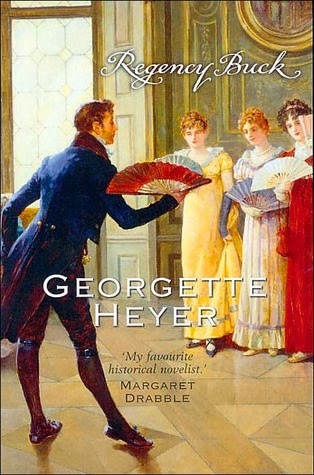
The book I’ve reread most often is perhaps Regency Buck (1935), a story of brother and sister who travel to London to force their reluctant guardian to bring them into society – a theme of many of her books. It has everything that is perfect in her Regency novels, a beautiful heroine, a dashing, slightly roguish hero, a lot of society nonsense and a mystery to boot.

Another great book is the aforementioned Cotillion, a delightful book I often read simply to feel good. Venetia (1958), The Grand Sophy (1950) and Devil’s Cub (1932) are among the top ten too, as are Arabella (1949), Lady of Quality (1972) and The Convenient Marriage (1934) – a book that has a heroine who stammers, only one example of many among Heyer’s heroines who aren’t utterly perfect and thereby lifeless.

My addiction subsided eventually. I had all the books that I wanted – I have never been interested in her detective stories – and had read them many times over. I haven’t stopped loving her books, though. She is still my go-to author, the one I pick up when I have nothing to read. It doesn’t matter which book I choose, or whether I read all of it or just parts, I’m guaranteed a wonderful time. I’m even considering buying all the books I already have as e-books. Partly because the Arrow imprints I bought in the 90s were such poor quality that the pages fell off after only one reading. Mostly, however, so that I would always have her books with me.

Do you have a favourite Heyer book, or hero or heroine? Please, share in comments.

Thursday, August 29, 2013

So very Dickensian


Oliver Twist is by far my favourite Dickens novel. Its not considered his best book and the musical Oliver! is more popular than the book. Seeing the movie version of the musical on TV is how I came to read the book myself when I was maybe twelve. The musical is very romantic, the tunes are catchy and the boy who played Oliver was very pretty. I had to read the book.

Oliver Twist by Charles Dickens
I wasn’t terribly surprised that the book was quite different from the musical. Bad things happen to Oliver and no one bursts to a song to make everything better. It didn’t matter, because the book ended as it ought to. Good people got their happy ending and bad people came to their just deserts.

Despite the harsher tone, I didn’t find it a particularly difficult book. Compared with The Black Brothers I had read earlier, a story of little chimney sweeps that is much grimmer at times, Oliver Twist was an easy story to digest. I was much older before I understood the wider picture of Victorian London and its poor, and the book got another dimension.

I had another reason to like the book too. Around the same time that I read it, our local theatre produced the musical. There was an open cast call for the child actors and quite a few from my class attended, me and my best friend among them. Alas, we weren’t cast – we were too young – but that didn’t diminish our enthusiasm. A girl we knew, a couple of years older, got the role of Oliver and she was brilliant. We saw the play many times and enjoyed it every time.

Most importantly, however, Oliver Twist remains my favourite Dickens because it’s pretty much the only one of his books that I have managed to complete reading, and not just once but twice. I find I much prefer his books in visual form. Luckily, there have been brilliant TV productions of many of his books for me to enjoy. Who knows, maybe one of them inspires me to take up the book too.

Here's a scene from a stage version of Oliver! that is both grim and overly romantic, Nancy's song As Long as He Needs Me.