Wednesday, September 09, 2020

The Seventh Perfection by Daniel Polansky: review

5/5 stars on Goodreads
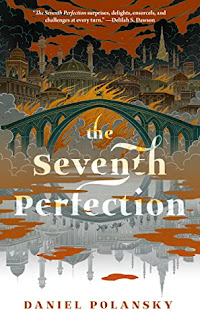
The Seventh Perfection by Daniel Polansky

Daniel Polansky’s books have been a hit and miss for me over the years, and after Those Below I decided I’d approach his works with great caution. Imagine my surprise, then, when I found myself requesting his upcoming book, The Seventh Perfection, from NetGalley. And since I was granted an early copy, I actually had to read it too.

I’m glad I did.

The Seventh Perfection is fantasy written in a style that I’ve only ever encountered in short stories before. Then again, the book almost falls into that category at only 160 pages, and I was able to read it in one sitting. The narrative consists solely of conversations the main character has with an array of people, but with a twist: her side of them has been removed completely. The reader is perfectly able to infer that she’s there from how the people talking to her refer to her presence. They comment on her questions, refer to something she does or says, or describe her looks or mood. And the whole time she remains silent.

I feared it would be difficult to get the hang of the story, but already by second page I was perfectly able to follow what was going on. It takes a while before there is enough information about the main character to form a picture of herif I hadn’t read the back copy I wouldn’t even have known she’s a womanbut all in all, the story was easy to follow.

Manet is seeking to unravel a mystery of a woman whose picture she has been sent in a locket by an anonymous person. Why her identity compels her isn’t made clear, and for the first half of the book I assumed she was on an official government business, as she is constantly referred to by her title amanuensis. Little by little, it becomes clear that she’s on a personal mission, that the woman’s identity matters to her, and that the God-King she serves isn’t happy about it. Mostly, because along the way, she learns the truth about how the God-King came to ascend in the first place.

The book is set in a world that is a mixture of fantasy and technology, but it’s only ever hinted at. There are no descriptions of surroundingsor people, for that matter. For some reason I kept imagining the town of Polansky’s Empty Throne duology, which worked fine, even though the towns aren’t all that similar. There are beings other than human that Manet encounters during her quest, and towards the end the interviews aren’t even with humans anymore. So, despite the lack of descriptions, the world emerges as rich and complex.

We learn a surprisingly lot about Manet, despite the fact that only the second to last chapter gives her voice. She emerges as a rather unlikeable personshe manages to anger almost everyone she encounters, her friends includedbut extremely determined. There is nothing she wouldn’t do to learn the truth. She is one of the few people who have learned the art of seven perfections, a discipline of body and mind, the seventh of which is a perfect memory. While this was interesting, the narrative style that erases her from the picture made her special skills go unused and unnoticed. It’s therefore slightly unnecessary that she is such a unique person. She could’ve been anyone, really.

The Seventh Perfection is an excellent book. It gets four stars for the story and the world, and an extra star for pulling off the chosen style with such skill. If you’re looking for a quick and surprisingly immersive read, I warmly recommend this one.


Tuesday, September 08, 2020

Architects of Memory by Karen Osborne: review

3/5 stars on Goodreads

Architects of Memory by Karen Osborne

Architects of Memory is a sci-fi novel by Karen Osborne and it starts the Memory War series. I received a free copy from NetGalley in exchange for an honest review.

I was really eager to read this book. Unfortunately it didn’t match my expectations and turned out to be an incredibly frustrating read. The plot takes forever to unfold and the reader isn’t helped along the way to figure out where it might take them. It takes them to a really unexpected place; in itself a good thing, but the lack of directions made me feel blindsided. Also the title of the book made me expect a completely different story. It took me over a half the book to realise that there will be no architects of memory and that memory manipulation doesn’t play any role in the story. Memories become erased, yes, but nothing new comes out of them. The series title, Memory War, is a more accurate guide for readers’ expectations.

The plot, once it unfolds, is fairly simple. The story is set in a future spacefaring world that is ruled by profitmaking corporations. It’s close enough to present timeline and earth that many cultural aspects from earth survive. People are either born as citizens of these corporations or they indenture themselves to them to earn a citizenship. Needless to say, this is fairly impossible and they are basically slaves. The corporations are at constant war with each other over resources, but it has come to a brief halt before the book begins because of a war with an alien race. The war is over, but when a powerful alien weapon is discovered, all the corporations want it, ostensibly to defeat the aliens. The plot is basically about the corporations fighting over the weapon.

The main point of view character is Ashlan. The book begins with an emotion dump about everything that is wrong with her life. In a couple of pages we learn that she’s dying, but she wants to make into a citizen before that, which makes her take risks. Her fiancĂ© has died of the same illness a year earlier. She’s since fallen in love again with her captain, but she’s dumped her for fairly vague reasons. Then Ash finds the weapon and it turns out she’s uniquely connected to it.

Ash is a character with practically no agency over her story. She goes where she’s told to, reacts to events around her, and whines about her fate. It isn’t until the very end that she tries to take matters to her own hand, only to be frustrated time and again. Her solution [SPOILER SPOILER SPOILER] is to kill herself. I kid you not. The book ends with thisthough with a twist that she doesn’t actually die. That’s where the inner logic of the book’s science finally failed me, not that I’d been terribly convinced by it along the way.

I didn’t like Ash at all, though part of it could be that I didn’t want to become emotionally attached to someone who might not be around for long. The rest of the characters weren’t any better. Maybe the attempt was to create nuanced characters, but the execution was so clumsy that they came across as sociopaths with zero control over their emotions. At one moment they were friendly, at next they were genocidal killers because of a past trauma, and back to likeable again. It was impossible to tell how any of them might react to any given situation or why they reacted the way they did. It was easier to not become attached to any of them. That included Captain Keller, the other point of view character. Both Ash and Keller claimed to be motivated by their love to each other, but since that had happened before the book began and the only interaction between the two was a fight before they became separated for most of the book, I found it a very unbelievable motivation.

A smoother narrative and better descriptions along the way, both the world-building and the characters’ emotions, might have made this a better read. In addition to these, the language was clunky at times, which I hope is only an issue with the early copy I read. But there are numerous ways with which to describe great thirst other than saying the ‘mouth was a desert’ over and over again, or describing nausea as ‘gulping the acid’. These may seem like small things, but they repeated so often that I started to pay attention. The ending reveals that the book has aspirations. I wish it could have achieved them too.

Tuesday, September 01, 2020

Don’t Hex and Drive by Juliette Cross: review

4/5 stars on Goodreads

Don't Hex and Drive by Juliette Cross

Don’t Hex and Drive is the second book in Stay a Spell series by Juliette Cross, and I received an early copy from NetGalley for reviewing. The series follows six sisters in New Orleans who are all witches with their special skills. The world also has vampires, werewolves and mysterious grimms, all living in secret from most of the humanity; though how that’s possible in the modern world of social media, I’m not sure.

I read the first two books back to back. Wolf Gone Wild is a nice paranormal romance, but not a very good book, as it has practically no plot and is filled with empty scenes that serve the romance but aren’t terribly exciting. Mateo is unable to shift into a wolf and suspects he’s been hexed and asks Evie to break the curse. But no one even investigates who’s cursed him and why. As a result, it’s the villain who gets to set the pace. The baddie shows up out of the blue in the last chapter and the entire story is acted out there. But I gave it three stars because I liked Evie and Mateo.

Wolf Gone Wild by Juliette Cross

In comparison, Don’t Hex and Drive is a much better and more interesting book. It has a proper plot that not only drives the actions of the characters but influences the romance as well. The book doesn’t seem like it’s been filled with empty scenes that only serve to inflate the word count. The mystery of women being kidnapped by vampires isn’t terribly mysterious and is solved easily in the end, but since this is a romance anyway, it doesn’t matter all that much. And the character motivations that drive the couple apart stem from their lives and are believable.

Isadora is a nice person, a witch with a great ability to heal and a tendency to keep herself in the background. But like with Evie in the first book, I had really hard time remembering that she’s in her late thirties and not early twenties. Devraj is a vampire tracker and a Bollywood star, an odd combination for someone who not only needs to keep his vampire side a secret, but has to go on missions that might take months. How the stardom came to be isn’t mentioned. He’s very charming, but I didn’t like him at all at first. He comes across as a bully who wants to push himself into Isadora’s life against her wishes. He turns better though, and I was able to enjoy their romance. And I think he redeemed himself in the end. There’s more sex in this book than the first one, but the scenes are well written and they fit the story well. And I’m really starting to like the Savoie sisters and will happily follow their stories.


Tuesday, August 25, 2020

Who Wants to Marry a Duke by Sabrina Jeffries: review

3/5 stars on Goodreads

Who Wants to Marry a Duke by Sabrina Jeffires

When it comes to historical romance, I tend to be set in my ways. I have a couple of favourite authors, like Suzanne Enoch, and I’m reluctant to try new ones. They disappoint too often. I hadn’t read Sabrina Jeffries before, but when I spotted her book at NetGalley, I decided to give her a chance.

Who Wants to Marry a Duke is the third book in a series called Duke Dynasty. Each book tells the love story of one of the siblings of a large family, on top of which there’s a continuous story of a murder investigation. I haven’t read the first two books, but it didn’t matter at all. The characters of the earlier books are introduced well, and the murder investigation doesn’t really kick in until here.

The main couple of this book is Olivia Norley and the Duke of Thornstock, or Thorne. (He does have a real name, but it’s never used and came as a bit of a surprise when I checked the book description just now.) They have a bit of past together. He has been forced to propose to her ten years earlier, but she’s refused. For some reason he’s held grudge for it ever since.

The murder investigation brings them together again. Olivia is an aspiring chemist, beggaring belief in those of us who want some historical accuracy (the book takes place in 1809), but it’s done well enough and I could let it stand. She’s hired by Thorne’s brother Grey to investigate the body of Grey’s father for traces of arsenic. Thorne wants to keep an eye on her, because he doesn’t trust her. But of the two, he’s the one who’s keeping secrets.

Olivia is a forthright character who is curious about everything new, including romance and sex. Thorne is slightly annoying with his hot and cold act, and the grudge he holds seems a little contrived and manufactured for the sake of drama. And when his secret is revealed, the following fight seems out of proportions for the transgression. They make up easily enough afterwards. But they’re a good couple together, Thorne especially grows as a person, and the naughty scenes are satisfying. All in all, a nice romance.

The murder investigation is the weakest part of the narrative and doesn’t really have much of a role despite starting the events. There’s a lot of conjecture about the identity of the villain(s) and their motives, but nothing concrete. The villains aren’t characters in this book, and despite some mayhem caused by them, there’s no suspense. And the murder isn’t even solved in the end.

What made me give only three stars, however, is that the book is one act too short. The last twist, the final push and test of the couple and their love never takes place. It’s even set up perfectly. There’s a probable threat to Olivia’s life, a mirror of an earlier attack, and Thorne rushes in to warn and protect her. But the attack never happens and the book just ends, followed by an epilogue that rehashes the murder investigation, lessening the emotional impact of the last chapter. So, a bit of a let-down in the end. But I liked the writing style well-enough that I’ll likely read the last book in the series, if only to find out who is offing the dukes and why.


Monday, August 10, 2020

Summer reading roundup

I took a few weeks off from this blog for a summer vacation and so haven’t updated anything since June. I didn’t stop reading though. On the contrary. Here’s a quick recap.

False Security by Lindsay Buroker

False Security by Lindsay Buroker continues her exciting UF series Death Before Dragons. In this fifth book, vampires are going missing, including Val’s vampire friend; Val accepts a job as a bodyguard to a tech billionaire, Zav takes her to the realm of elves to see her father, and Val ends up with roommates—and a new house too. For a woman who’s kept people at arm’s length, she’s building a nice new family for herself. Zav talks a lot about vigorous mating, now that he’s officially claimed her, but nothing really happens. There’s a lot of action, like always, and the final battle has bears and naked vampires in it. You don’t want to miss it. (4/5 stars on Goodreads)

Twisted Twenty-six by Janet Evanovich

Twisted Twenty-six is the latest in Janet Evanovich’s long-running Stephanie Plum mystery series. The series has felt tired for quite long now, but here it returns to its old form—to an extent. The stakes are genuinely high, violence has consequences, and humorous incidents don’t dominate everything else. Stephanie takes stock of her life, giving an impression of continuity between the books, which is usually lacking. Lesser side characters, Connie and Stephanie’s parents included, have actual roles. And the ending hints at the same story continuing in the next book. I’m really looking forward to it. (4/5 stars on Goodreads)

False Value by Ben Aaronovitch

False Value is the eight book in Rivers of London series by Ben Aaronovitch, and it doesn’t let down. I had a brief scare at the beginning that Peter wouldn’t be his usual copper self, but luckily that didn’t turn out to be the case, as he’s undercover. The first part of the book was slightly different than usually, as it was told in alternating chapters in the present and the past to set up the reason for Peter’s latest assignment. Once that was over, the story advanced in the usual meandering manner where the reader isn’t entirely sure what’s going on until it’s all over. There was a bit more Beverly in this book than before—she is pregnant after all—and she is becoming a real person, but the other side characters remain a bit two dimensional. This includes the staples like Nightingale and Sergeant Guleed. There was some mayhem at the end, but Peter managed not to destroy half of London this time round. I’m not sure if I’m disappointed or not about that. (4/5 stars on Goodreads)

Engagement and Espionage by Penny Reid

Engagement and Espionage is a spinoff of Winston Brothers series by Penny Reid and starts a new Solving for Pie series. It features Cletus, the devious mastermind in hillbilly’s body, and his betrothed Jennifer the pie queen, and it’s a mystery, not romance—most of the time. The mystery of strangled chickens wasn’t terribly difficult to solve, but Jenn’s strained relationship with her parents took some work. And the two of them just couldn’t catch a break, mostly because Cletus couldn’t see past his romantic machinations. It was fun and emotional, like Ms Reid’s books usually are. I’ll definitely read the next book. (4/5 stars on Goodreads)

Queen’s Gambit by Karen Chance

Queen’s Gambit continues Karen Chance’s Dorina Basarab UF series. It’s the fifth book, but as the series is parallel with Chance’s other, longer series, it feels like Dory’s been around forever. The book has a promising start: a sneak attack separates Dory and Dorina, giving the latter a body of her own. From there, we follow two separate adventures, as they both try to figure out what has happened, why and by whom, and how to get back together again.

Unfortunately, instead of a proper plot, we have endless battles in both storylines, some of which don’t really have anything to do with the actual aim of the book. And then the book ends without any conclusion to either story. Dory ends up where she began, practically none the wiser, and Dorina’s story ends with a kind of a cliff-hanger.

Of the two stories, I liked Dorina’s better, as she has for the first time a chance to reflect her weird existence within Dory. Dory’s storyline evolved into endless discussion about her marriage with Louis-CĂ©sare, which got old after a while. The only good thing I can say about it is that they managed to talk things through and reach some sort of understanding.

This was not my favourite in the series by any means. But these books have had greatly uneven quality before, so I’m not giving up yet. And the way Dorina’s story ended, it gives me hope that the two series will connect properly for the first time in the next book. We’ll see. (3/5 stars on Goodreads)

The Enforcer Enigma by G. L. Carriger

The Enforcer Enigma is the third book in San Andreas Shifters M/M paranormal romance series by Gail Carriger, writing as G.L. Carriger. It’s been a while since I read the previous book, but it felt like coming home, warm and cosy. The characters and the entire pack are coming together nicely and they’re not constantly on defensive anymore, which changes the dynamic of the story.

Perhaps that’s why it felt like the love story of Colin and Judd took a backseat to the main plot. It was a nice mystery plot that was solved really fast, but I really would’ve liked to read more of the lovely pair. That said, the two stories went hand in hand, there were really good moments between the pair and it felt believable all the way. Colin opened up nicely and Judd finally found his home in Colin. On top of that, Trick was a great new addition to the group and I’ll definitely read how it’ll turn out with his bear in the next book. (4/5 stars on Goodreads)

On top of these books, I read a few I’d received free from NetGalley. I’ll write separate reviews of those later.